
Why Did America Ban Raw Milk
and Require Pasteurized Milk Instead?
(It Had Nothing to Do With Disease)
In 1858 a man named Gail Borden patented a way to boil milk down into a thick syrup that could sit on a shelf for years without spoiling. He called it condensed milk. Heat from the evaporation process can degrade or destroy sensitive vitamins like Vitamin C and some B vitamins. The same is true for pasteurization. Within ten years his factories were the largest of their kind in the world. Within 30 years every major city in America had laws on the books forcing dairy farmers to deliver their milk through centralized processing plants. By 1910, raw milk, the same milk that had fed every human civilization for 6,000 years was being called a public health hazard. But here is the part nobody talks about. The disease outbreaks they used to justify the laws happened in cities that were already pasteurizing their milk. The scientists they paid to write the studies were funded by the same families that owned the dairy trusts. And the small farms that fed neighborhoods for generations with fresh raw milk were shut down and condemned.
An entire way of life was replaced. The food on your table used to come from less than a mile away. It was local. People were independent. No refrigerated trucks, no grocery stores, no brand names. No centralization. In 1850 the typical American family did not buy milk. They got it from a cow they owned. Or from a neighbor down the road. Or a small dairy at the edge of town that delivered fresh milk in glass bottles every morning before sunrise. The milk was warm when it arrived. It still smelled like the field. It had cream that rose to the top in a thick rich layer that you could spoon off and churn into butter. It contained living enzymes, native bacteria and a full spectrum of fats and minerals that the human body had been created to digest for thousands of years. People were not getting sick from this milk. Not in the small towns. Not in rural counties. Not on the farms.
The disease problem, the one we are told justified the entire pasteurization movement, was almost entirely a city problem. And it was almost entirely a problem in one specific kind of city dairy -- the swill dairy. What was happening in them was not the failure of raw milk. It was a deliberate corruption of it. The swill dairies were industrial operations attached to whiskey distilleries in cities like New York, Brooklyn, Philadelphia and Cincinnati. The distilleries produced a waste product called swill, which was the spent grain mash left over after the alcohol was extracted. This swill was hot, fermented, nutrient-stripped and so corrosive that it ate through wooden troughs. The distilleries didn't want to pay to dispose of it, so they built massive cattle sheds next to the stills and pumped the swill straight into feeding troughs. Cows that should have been grazing on grass, were locked in dark stalls, some standing in their own waste up to their knees. Fed nothing but distillery slop until their teeth fell out and their tails rotted off. There are documented cases of cows so weak they had to be tied up to be milked because they could no longer stand on their own. The average life span of these cows was six months. The milk that came out of these animals was of course deadly. It was thin, blue, and so nutritionally degraded that it had to be mixed with chalk, plaster of paris, starch, eggs and molasses just to look like real milk. Children who drank it died by the thousands. In New York city alone, the infant mortality rate from contaminated swill milk was estimated at 60% in some neighborhoods.
A reformer named Robert Hartley wrote an entire book about it in 1842, entitled An Historical, Scientific and Practical Essay on Milk. He documented the Swill Dairies in graphic detail. He named the distilleries. He named the politicians who protected them. The city inspectors who took bribes to look the other way. He showed that the cows in those sheds had open sores oozing pus into the milk pails. He showed that the milk was being delivered to orphanages and tenement houses where it was the primary food for infants whose mothers couldn't nurse. The book caused a scandal. Investigations were launched. Headlines were written -- and then almost nothing happened. The swill dairies kept operating for another 40 years because the men who owned them were the same men who owned the newspapers, the city council seats, and the tax collectors. What finally closed the swill dairies was not pasteurization and not reform legislation. What closed them was the railroad. Once refrigerated rail cars made it possible to bring fresh country milk into the city in bulk, the swill dairy business model collapsed on its own. The cities didn't need pasteurization to fix the swill problem. The swill problem was already fixing itself.
But then the pasteurization campaign began. If pasteurization had really been about the swill dairies, the laws would have come in the 1850's and 1860's when the crisis was at its peak. Instead the laws came in the 1890's and 1900's after the crisis had already passed and after the rural milkshed had become a viable competitor to the urban industrialists. Chicago became the first American city to pass a mandatory milk pasteurization law in 1909. Michigan became the first state to legislate a statewide milk pasteurization requirement in 1947. The laws were not aimed at the disease. They were aimed at the competition. Why was the "solution" heat treatment of all milk? Why not rather simply shut down the swill dairies? Why also include the clean, raw milk from rural farms that had nothing to do with the swill dairies? The answer is because the people pushing pasteurization were not actually trying to solve the swill dairy problem. The swill dairy problem was the cover story. The real goal was to get rid of small dairies entirely, so big industry could control milk. Massive centralized plants could not compete with small dairies on price, quality or freshness. So they made it illegal. Pasteurization was the weapon. Once a city passed a law requiring all milk sold within its limits to be pasteurized, the small farmer was finished. He couldn't afford the equipment or inspections, or licensing fees or centralized bottling. The only operations that could meet the new requirements were the ones owned by the men who had lobbied for the laws in the first place. Within 20 years the dairy landscape had been completely rewritten in America. Tens of thousands of small dairies were gone. Cows were moved into massive industrial feedlots. Milk was shipped hundreds of miles, heated, homogenized, stripped of cream, re-fortified with synthetic vitamins and sold back to the same people who used to produce it themselves. The entire transformation was sold to the public as a triumph of science and public health.
According to the CDC's own records, raw milk causes a tiny fraction of food-borne illness compared to commercial leafy greens, deli meats, factory eggs, and pasteurized soft cheeses. The risk has been measured and it is statistically negligible compared to almost any other food on the modern American shelf. Yet the legal regime treats it as poison. Why? Because the legal regime was never about safety. The legal regime was about market control. A glass of fresh, raw milk from a grass-fed cow contains live enzymes, beneficial bacteria, butyrate, conjugated linoleic acid, vitamin K2, full spectrum fats, and bio-available calcium in a form the body recognizes. A glass of pasteurized, homogenized, industrial milk contains denatured proteins, oxidized fats, dead enzymes, residual antibiotics, hormone traces, and a bleached white liquid that would have been unrecognizable to any human swho lived before 1900. We are assured that the second is the safe version and the first is the dangerous version. Who benefitted by switching the labels?
The downward spiral from raw milk to pasteurized, homogenized milk is a slide from nutritional to depleted; local to distant; independent control yourself to requiring permission and licenses from others in control; free to costly;
decentralized to centralized. This same pattern is found in what was done to 1.) iodine sourdough nutritional bread that eventually was replaced with bromated bleached depleted bread, 2.) mineral spring water that was eventually replaced with bottled distilled water, 3.) herbal medicine, vitamins, minerals & midwives replaced with synthetic drugs, surgery & radiation, 4.) butter replaced with margarine, Crisco & industrial cooking oils, 5.) Celtic sea salt or Himalayan pink salt replaced with NaCl, 6.) Homeschooling & Bible with McGuffey Readers replaced with state schools & textbooks that have expelled God and the Bible while inserting evolution & other lies. Etcetera.
What is Real Milk?
(A Campaign for Real Milk is a project of The Weston A. Price Foundation, PMB 106-380, 4200 Wisconsin Avenue, NW Washington, DC 20016. For sources of Real Milk call (202) 363-4394 or visit www.realmilk.com)
Real Milk comes from real cows that are fed real pasture grass -- not grain fed. The milk is full-fat (cream at top) and unprocessed (raw) -- unpasteurized and unhomogenized.
The source of most commercial milk is the modern Holstein,* bred to produce huge quantities of milk–three times as much as the old-fashioned cow. She needs special feed and antibiotics to keep her well. Her milk contains high levels of growth hormone from her pituitary gland, even when she is spared the indignities of genetically engineered Bovine Growth Hormone to push her to the udder limits of milk production.
*Please note, there are farmers who produce excellent “Real Milk” using older lines of Holsteins and Holstein crosses (Holsteins who can survive on grass are “old-fashioned”). It is the modern commercial Holstein, bred only for quantity, not quality, and pumped full of hormones and antibiotics, that should be avoided. Know your supplier! Ask questions!
Join A Campaign for Real Milk: Buy only milk from old-fashioned breeds of cows, such as but not limited to Jerseys, Guernseys, Red Devons, Brown Swiss, Milking Shorthorns, Dutch Belted, or older genetic lines of Holsteins, or from goats or sheep. (Or, depending on what part of the world you live in, from llamas, water buffalo, or reindeer!)(camels, mares, and donkeys produce non-kosher milk).
Real Milk comes from real cows that eat real feed.
Real feed for cows is green grass in Spring, Summer and Fall; stored dry hay, silage, hay and root vegetables in Winter. It is not soy meal, cottonseed meal, corn or other commercial feeds, nor is it bakery waste, chicken manure or citrus peel cake, laced with pesticides. Vital nutrients like vitamins A and D, and Price’s “Activator X” (a fat-soluble catalyst that promotes optimum mineral assimilation, now believed to be vitamin K2) are greatest in milk from cows eating green grass, especially rapidly growing green grass in the spring and fall. Vitamins A and D are greatly diminished, and Activator X disappears, when milk cows are fed commercial feed. Soy meal has the wrong protein profile for the dairy cow, resulting in a short burst of high milk production followed by premature death. Most milk (even most milk labeled “organic”) comes from dairy cows that are kept in confinement their entire lives and never see green grass!
Join A Campaign for Real Milk: Buy only milk products from herds allowed to graze on green pasture.
Real Milk is not pasteurized.
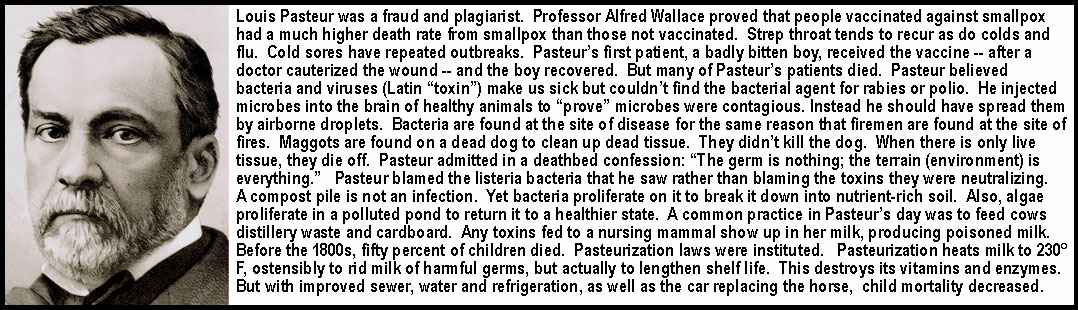
Pasteurization destroys enzymes, diminishes vitamin content, denatures fragile milk proteins, destroys vitamins C, B12 and B6, kills beneficial bacteria, promotes pathogens and is associated with allergies, increased tooth decay, colic in infants, growth problems in children, osteoporosis, arthritis, heart disease and cancer. Calves fed pasteurized milk do poorly and many die before maturity. Raw milk sours naturally but pasteurized milk turns putrid; processors must remove slime and pus from pasteurized milk by a process of centrifugal clarification. Inspection of dairy herds for disease is not required for pasteurized milk. Pasteurization was instituted in the 1920s to combat TB, infant diarrhea, undulant fever and other diseases caused by poor animal nutrition and dirty production methods. But times have changed and modern stainless steel tanks, milking machines, refrigerated trucks and inspection methods make pasteurization absolutely unnecessary for public protection. And pasteurization does not always kill the bacteria for Johne’s disease suspected of causing Crohn’s disease in humans with which most confinement cows are infected. Much commercial milk is now ultra-pasteurized to get rid of heat-resistant bacteria and give it a longer shelf life. Ultra-pasteurization is a violent process that takes milk from a chilled temperature to above the boiling point in less than two seconds. Clean raw milk from certified healthy cows is available commercially in several states and may be bought directly from the farm in many more. (Sources are listed on www.realmilk.com.)
Join A Campaign for Real Milk: Demand access in all states to clean, raw milk. Boycott processed milk!
Real Milk is not homogenized.
Homogenization is a process that breaks down butterfat globules so they do not rise to the top. Homogenized milk has been linked to heart disease.
Join A Campaign for Real Milk: Use only milk with “Cream on the Top.”
Real Milk contains butterfat, and lots of it!
Average butterfat content from old-fashioned cows at the turn of the century was over 4% (or more than 50% of calories). Today butterfat comprises less than 3% (or less than 35% of calories). Worse, consumers have been duped into believing that low-fat and skim milk products are good for them. Only by marketing low-fat and skim milk as a health food can the modern dairy industry get rid of its excess poor-quality, low-fat milk from modern high-production herds. Butterfat contains vitamins A and D needed for assimilation of calcium and protein in the water fraction of the milk. Without them protein and calcium are more difficult to utilize and possibly toxic. Butterfat is rich in short- and medium chain fatty acids which protect against disease and stimulate the immune system. It contains glyco-spingolipids which prevent intestinal distress and conjugated linoleic acid which has strong anticancer properties.
Join A Campaign for Real Milk: Buy only full-fat milk products.
Real Milk contains no additives.
Powdered skim milk, a source of dangerous oxidized cholesterol and neurotoxic amino acids, is added to 1% and 2% milk. Low-fat yogurts and sour creams contain mucopolysaccharide slime to give them body. Pale butter from hay-fed cows contains colorings to make it look like vitamin-rich butter from grass-fed cows. Bioengineered enzymes are used in large-scale cheese production. Many mass produced cheeses contain additives and colorings and imitation cheese products contain vegetable oils.
Join A Campaign for Real Milk: Boycott counterfeits.
Real Milk can save family farms.
Pasteurization laws favor large, industrialized dairy operations and squeeze out small farmers. When farmers have the right to sell unprocessed milk to consumers, they can make a decent living, even with small herds.
Why a Campaign for Real Milk?
Back in the 1970s, a couple of blokes were sitting in an English pub, bemoaning the consolidation of the brewing industry in England and the decline of British beer and ale. A commodity that represented the soul of Britain–carefully brewed ales from countless small-scale manufacturers, each with a distinctive color and taste–had been edged out by the insipid canned beers of a few large monopolistic breweries. What was needed, they decided, was a return to traditional brewing methods. They launched A Campaign for Real Ale, which soon became the force that turned back the mega-brewers and reinstated varied and delicious ales to English tables and pubs.
Back in the 20s, Americans could buy fresh raw whole milk, real clabber and buttermilk, luscious naturally yellow butter, fresh farm cheeses and cream in various colors and thicknesses. Today’s milk is accused of causing everything from allergies to heart disease to cancer, but when Americans could buy Real Milk, these diseases were rare. In fact, a supply of high-quality dairy products was considered vital to American security and the economic well being of the nation.
What’s needed today is a return to humane, non-toxic, pasture-based dairying and small-scale traditional processing, in short . . .A Campaign for Real Milk.
Real Milk–Nature’s Perfect Food
Galen, Hippocrates, Pliny, Varro, Marcellus Empiricus, Bacchis and Anthimus, leading physicians of their day, all used raw milk in the treatment of disease. During the 1920s, Dr. J. E. Crewe of the Mayo Foundation used a diet of raw milk to cure TB, edema, heart failure, high blood pressure, prostate disease, urinary tract infections, diabetes, kidney disease, chronic fatigue and obesity. Today, in Germany, successful raw milk therapy is provided in many hospitals.
Studies show that children fed raw milk have more resistance to TB than children fed pasteurized milk (Lancet, p 1142, 5/8/37); that raw milk is very effective in preventing scurvy and protecting against flu, diphtheria and pneumonia (Am J Dis Child, Nov 1917); that raw milk prevents tooth decay, even in children who eat a lot of sugar (Lancet, p 1142, 5/8/37); that raw milk is better than pasteurized milk in promoting growth and calcium absorption (Ohio Agricultural Experiment Station Bulletin 518, p 8, 1/33); that a substance present in raw cream (but not in pasteurized cream) prevents joint stiffness and the pain of arthritis (Annual Review of Biochemistry, 18:435, 1944); and that children who drink raw milk have fewer allergic skin problems and far less asthma than children who drink pasteurized milk (Lancet 2001 358(9288):1129-33).